

Biohacking technology devices can support health optimization by measuring signals such as sleep, activity, and heart rate variability, or by delivering structured light, sound, and environmental inputs. The strongest approach starts with one clear outcome, establishes a baseline, and selects tools with credible mechanisms, practical usability, and appropriate safety boundaries.
This guide applies a Nervous System First lens to the category. You will learn how to separate measurement from intervention, compare device types, build a stack without chasing novelty, and interpret results without confusing self-tracking with medical diagnosis. First, it helps to define what belongs in this increasingly broad category.
What Are Biohacking Technology Devices, Really?
Biohacking technology devices are tools that measure or influence a defined aspect of wellbeing, performance, or environment. They include wearables, light and sound systems, nervous-system wearables, and environmental tools. Evaluate each one by its intended use, mechanism, evidence, instructions, and fit within a repeatable routine.
Biohacking technology devices help you observe or influence specific aspects of performance and wellbeing. The category includes more than wearable trackers. It also includes neurological, environmental, photobiomodulation, and cellular-support systems. The key question is not whether a device sounds advanced. It is whether its purpose, mechanism, evidence, and place in your routine are clear.
Measurement and intervention are different jobs
Some devices primarily measure. A wearable may collect signals related to sleep, activity, or heart rate variability, giving you a more objective view of patterns that are otherwise easy to misjudge. Measurement does not automatically create change, however. It gives you information that can support a decision, such as adjusting training load, protecting a sleep window, or noticing how a routine affects your perceived recovery.
Other devices influence an experience or state. A neurological device may use visual or sensory input to support focus, relaxation, or a shift in nervous-system state. A light-based system may deliver a defined wavelength within a structured routine. These are interventions, not diagnostic instruments. Assess them through the proposed mechanism, protocol clarity, and your response over time.
Keeping these roles separate prevents a common error: treating a metric as a medical verdict or treating a subjective feeling as proof that a device works for everyone. A useful device can still have a narrow purpose. Define that purpose before you buy, then decide what observation would tell you whether it is earning a place in your routine.
Why Nervous System First changes the selection process
Upper Aeon's approach places nervous-system regulation before aggressive optimization. A body and mind operating under constant load may not benefit from more stimulation, tracking, or protocols. Regulation becomes the foundation for physical and mental optimization, rather than an afterthought. This does not make every device a nervous-system tool. It gives you a sequence for evaluating effects.
Start by asking what state you want to support. Is the need steadier focus, a calmer transition into sleep, greater body awareness, or a consistent recovery routine? Then ask whether the device moves you toward that state, merely records it, or adds another variable. The answer may point toward measurement, state support, or no new device.
This framework also favors integration over isolated gadget use. Neurological optimization is most useful when it sits inside a cohesive lifestyle design framework, including sleep, movement, light exposure, nutrition, relationships, and periods of genuine recovery. A device may support a routine, but it cannot replace the routine that gives its signal or intervention meaning.
What separates a useful device from a persuasive gadget?
Use a disciplined filter. Look for clinical research where relevant, a peer-reviewed mechanism of action, and meaningful real-world testing. These criteria do not guarantee a personal result, but they help distinguish a defined tool from vague promises. Be especially careful with claims that imply treatment, prevention, or guaranteed transformation. Customer-provided methodology identifies research quality, mechanism, and real-world use as core selection criteria, not optional extras.
Finally, place the device inside a broader philosophy of conscious biohacking. The goal is not to outsource awareness to technology. It is to use technology with enough discernment that data, embodied experience, and repeatable habits inform one another. For a deeper view of that bridge between modern tools and embodied practice, explore the principles of conscious biohacking.
Start With Data: Wearables, HRV, and Metabolic Signals
Before adding another device, establish a clear picture of how you are functioning now. A baseline makes self-experimentation repeatable. Track a small set of signals under ordinary conditions. Keep the measurement window consistent. Record context such as sleep timing, training load, alcohol, travel, illness, and unusual stress. The goal is not the largest dashboard. It is a pattern that can inform one deliberate change.
Use HRV as a trend, not a verdict
Heart rate variability, or HRV, describes variation in the time between consecutive heartbeats. Consumer wearables use HRV to provide context about autonomic activity, stress, and recovery. The measure is useful, but one morning score cannot explain your nervous-system state. Compare readings under similar conditions and look for multi-day patterns. An academic review of wearable HRV discusses this role and its limits.
HRV biofeedback differs from passive tracking. It gives immediate feedback while you practice controlled breathing or another regulation exercise. A PubMed-indexed review reports that portable HRV biofeedback can help with stress and mental health difficulties. A healthy-adult study also found improvements in subjective sleep quality and autonomic activation. These findings support structured practice, not diagnosis. Review the PubMed evidence and the mobile HRV biofeedback study.
Pair sleep and activity data with lived experience
Wearables can provide metrics related to sleep, activity, and other physiological measures. That makes them useful for noticing relationships you might otherwise miss. You may find that late training, shortened sleep, or schedule disruption coincides with lower next-day readiness. The wearable does not replace your own report. Ask whether the reading matches your energy, mood, focus, and perceived recovery. The CDC describes wearable technology and its uses.
Sensor output also contains noise. Fit, skin contact, movement, algorithm changes, timing, and device differences can affect results. Research on wearable-derived HRV emphasizes sensor accuracy and data noise. A validation study found strong correlation between some consumer measures of nocturnal resting heart rate and HRV and clinical devices. Correlation is not equivalence. Check the clinical review and the consumer validation study.
Put CGM readings in context
Continuous glucose monitors, or CGMs, were developed primarily for diabetes management. They use a small wearable sensor to track glucose through the day and night. Health-conscious users may also examine how meals, sleep, stress, and activity relate to glucose patterns. A reading is context, not a diagnosis or a universal scorecard for food. The CDC explains CGM measurement and use.
The same principle applies across biohacking technology devices: measure first, change one variable, then reassess. A baseline protects you from attributing every fluctuation to a new intervention. It also helps you choose tools that answer a real question, such as recovery consistency, sleep timing, or metabolic response. For a practical next step, explore wearable biohacking stress relief devices alongside a simple protocol for what you will track and why.
Which Biohacking Technology Devices Fit Your Goal?
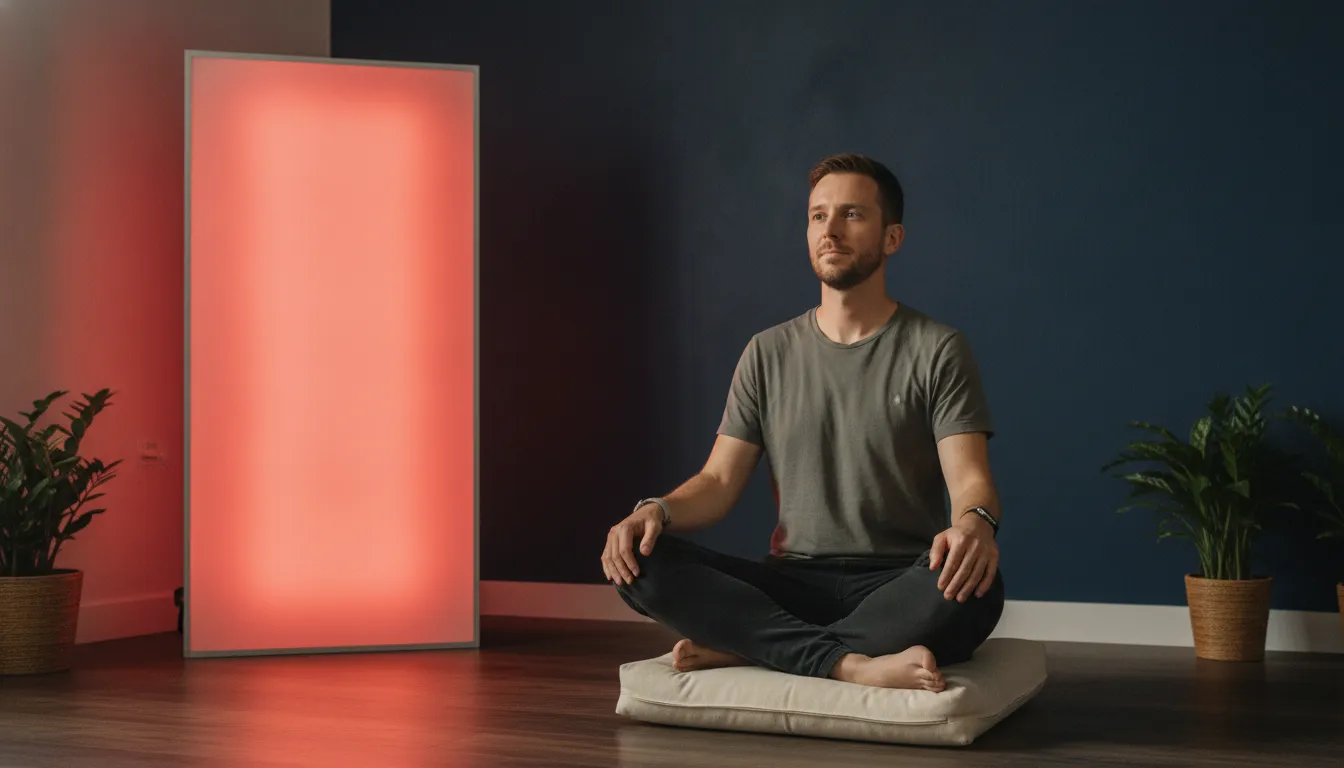
The right device depends less on novelty than on the outcome you want to observe or support. Start by separating measurement from intervention. A measurement tool helps you see patterns. A neurological, light, environmental, or recovery tool is intended to influence the conditions around a practice. That distinction keeps your protocol clear and makes it easier to evaluate whether a device belongs in your routine.
| Category | Best fit | What to evaluate | Useful starting question |
|---|---|---|---|
| Measurement | People tracking personal patterns | Signal consistency and whether the data changes a decision | Will the signal change a decision? |
| Neurological and light | People prioritizing focus, relaxation, nervous-system state, or light protocols | Mechanism, instructions, wavelength or sensory input, and evidence for the use case | Am I choosing state support or a light-based cellular protocol? |
| Environmental | People refining the conditions in which they sleep, work, or practice | Whether the intervention addresses a defined environmental variable without making disease claims | What feature of my environment am I actually trying to change? |
| Recovery | People building repeatable downshifting, restoration, or body-mind awareness practices | Whether the device complements sleep, movement, and regulation rather than replacing them | Can I use this consistently and assess the experience over time? |
Measurement devices are often the most useful first step when your goal is behavioral clarity. They can establish a baseline before you add an intervention, but a metric is not a diagnosis. Pair the signal with a decision, such as adjusting training load, reviewing sleep habits, or changing a practice's timing. If the data never changes your behavior, a more advanced sensor may not improve your outcome.
NeuroVIZR for visual and auditory state support
NeuroVIZR sits in the neurological category. Upper Aeon describes it as a visual brainwave-entrainment device for mental clarity and shifts in nervous-system state. It suits someone seeking a structured focus or relaxation practice. It is not a substitute for clinical care or a guarantee of cognitive improvement. Explore the NeuroVIZR light and sound device for current guidance.
Use a tool like this with a defined protocol. Choose one context, follow the supplied instructions, and note how you feel before and after. Keep the rest of your routine stable during the first few sessions. This creates a more useful personal comparison than changing several variables at once. Neurological optimization is strongest within a lifestyle that includes sleep, movement, attention, and recovery.
CERA and the role of photobiomodulation
CERA belongs in the light and recovery conversation. Upper Aeon describes the CERA System as providing advanced resonance-based protocols intended to support body-mind awareness and optimization. Read that as a protocol and awareness tool, not as a medical treatment claim. The CERA dual-zone light system is the appropriate place to confirm current product details and usage guidance.
When evaluating light devices, wavelength matters. Red and near-infrared wavelengths differ in penetration depth and cellular effects, as described in this photobiomodulation review. Published literature also discusses photobiomodulation applications such as wound healing and skin-condition management in this PBMT review. One proposed mechanism involves mitochondrial activity and ATP synthesis. That mechanism does not guarantee a personal result.
Choose the category that matches the decision in front of you. Then verify the mechanism, follow the protocol, and assess whether the device earns a stable place in your life.
Nervous System Regulation and Environmental Tools
Optimization becomes more sustainable when the environment supports the state you are asking the body to access. Upper Aeon's Nervous System First approach places regulation before intensity. Rather than collecting devices because they are novel, consider whether a tool helps create the conditions for focus, recovery, or embodied awareness. This is especially relevant for people whose days alternate between demanding cognitive work, constant connectivity, and limited opportunities to reset.
The Apollo Wearable is designed around that principle. It provides gentle vibrations intended to prime the nervous system for focus or relaxation. 'Prime' is the useful word here. The device is not a replacement for sleep, movement, breathing practices, or professional care. It is an adjunct to a deliberate routine, creating a consistent cue before a work block, meditation session, travel day, or evening wind-down. Your response is the deciding data point. Notice whether the setting supports your goal without adding stimulation.
Use environmental design as a form of regulation
Not every useful intervention needs to be worn or measured. Lighting, sound, device placement, and the character of a bedroom or workspace can reinforce regulation or interrupt it. An evening environment usually begins with fewer competing signals: lower-intensity light, less stimulating content, and a clear transition away from work. In the morning, intentional light exposure and movement can help mark the active part of the day. Test these lifestyle choices against actual sleep quality, energy, and mood.
EMF mitigation belongs in the same category: environmental choice, not disease treatment. The customer profile identifies safe, health-conscious home environments and EMF protection as priorities for conscious parents. That does not justify claiming that a product prevents illness or cures symptoms. A more responsible approach is to reduce unnecessary exposure where it is easy. Create distance from devices during rest. Review what remains powered beside the bed. Design technology-free periods at home. Treat these changes as preference-based experiments that may make the space feel calmer, rather than as medical interventions.
Match the tool to the state, then observe
Environmental tools work best when they are connected to a repeatable intention. You might pair Apollo with a pre-meeting focus ritual, a softer setting with breathwork, or a low-stimulation bedroom with a consistent sleep schedule. Record the context briefly: time, intended state, device setting, and your subjective response the next day. If sleep becomes worse, anxiety increases, or the routine feels intrusive, pause and reassess instead of escalating. Nervous system support should expand your agency, not create dependence on a gadget. If your framework includes breath, posture, or other vagal regulation practices, review Upper Aeon's guide to vagus nerve stimulation biohacking devices as a complementary educational resource, not a substitute for clinical advice.
For readers who want to explore this approach with others, community can add accountability and practical perspective. Upper Aeon's Earth 2 community connects technology choices with broader embodiment and lifestyle practices. Keep the device inside a larger framework rather than treating it as a standalone answer.
The wider category includes neurological optimization, EMF mitigation, photobiomodulation, and cellular support. These labels describe different uses, not interchangeable outcomes. Start with one environmental friction. Choose one modest change. Give it consistent time, then assess whether it improves the state and routine you are building.
How to Build a Device Stack Without Chasing Hype
A sophisticated stack is not a crowded shelf. It is a small, testable system in which each device has a defined role, a measurable reason for being there, and a realistic place in your daily life. Upper Aeon's approach treats nervous system regulation as the foundation, then layers tools around a specific outcome rather than pursuing novelty for its own sake.
That distinction matters for ROI. High-performing people often want more energy, focus, or recovery without creating another demanding project. More devices can mean more cost, setup, and confounding variables. A curated stack can produce better learning. You can identify what changed, what did not, and what is worth repeating.
- Define one outcome in observable terms. Choose a decision you can evaluate over four to eight weeks. "Optimize my health" is too broad. "Improve my transition into focused work" or "create a more consistent evening wind-down" is specific enough. Add one constraint, such as time, budget, portability, or family use. The goal is to make the experiment useful, not to promise a result.
- Establish a baseline before buying or combining tools. Record the signals that relate to your objective, along with simple context notes. Depending on the goal, that may include sleep duration, perceived recovery, training load, resting heart rate, HRV, or a daily focus rating. Wearable data can help you observe patterns, but sensor accuracy and environmental noise still require careful interpretation. Baseline information also protects you from mistaking a new-device effect for a normal fluctuation.
- Add one meaningful variable at a time. Select the tool that directly addresses the outcome and use it according to its instructions. For nervous system priming, evaluate a wearable designed for focus or relaxation. For light protocols, consider wavelength, use case, and evidence rather than treating every red-light product as interchangeable. Upper Aeon's criteria emphasize clinical research, peer-reviewed mechanisms, and real-world testing. Review top biohacking tools for energy and focus for a curated starting point.
- Review outcomes and total cost, not just impressions. At the end of your test period, compare observations with baseline. Ask whether the signal moved in the desired direction and whether the effect was repeatable. Weigh the time, money, maintenance, and attention required. A device may be interesting yet deliver poor ROI if it stays unused or creates metric anxiety. Keep a simple adherence and context log.
- Integrate cautiously, then earn the next layer. If the first tool fits your routine and produces a credible signal, add a second device only when it has a distinct role. Stacking can combine priming with another modality, but the rationale should be explicit. Keep the variables understandable. Upper Aeon describes stacking as part of lifestyle design, not a substitute for sleep, movement, nourishment, or regulation. Keep the stack small enough to audit. Pause anything that produces concerning symptoms.
The best biohacking technology devices are therefore not the most dramatic or expensive. They are the ones you can use consistently, interpret responsibly, and connect to a coherent protocol. Evidence, lived experience, and community-verified practice can inform the decision, but no product should outrank your ability to observe, adapt, and stay aligned with the outcome that matters.
Safety, Interpretation, and the Limits of Self-Tracking
Data can sharpen a protocol, but it cannot turn a consumer device into a diagnostic instrument. A wearable may show a change in heart rate variability, sleep, glucose, or activity. That observation is useful for asking better questions. It is not, by itself, proof of a disease, a treatment effect, or a biological cause.
Start with the device's intended use and operating instructions. Follow the stated wear time, placement, charging, cleaning, calibration, light exposure, vibration settings, and session limits. A protocol that feels sophisticated is not automatically safer or more effective when used more often. For light, sound, vibration, or other neurological tools, begin conservatively and stop if the experience produces unusual discomfort, agitation, dizziness, visual disturbance, headache, or other unexpected symptoms. Do not modify a device or combine modalities in ways the manufacturer does not support.
Know when self-experimentation is not the right tool
Consult a qualified clinician before using a device for a medical concern, or before changing a medication, diet, exercise plan, or treatment based on its readings. That boundary is especially important during pregnancy, when taking prescription medication, when managing diabetes or another chronic condition, or when you have an implanted electronic or medical device. A clinician can assess whether a device is appropriate, interpret the data alongside your history, and identify when an apparent signal needs formal testing.
Continuous glucose monitoring is a clear example of why context matters. The CDC explains that CGMs continuously track glucose throughout the day and night, and health-conscious users may also explore patterns related to meals and lifestyle. That does not make every fluctuation clinically meaningful. If readings conflict with how you feel, appear implausible, or suggest a potentially urgent problem. Verify them through the appropriate medical channel rather than trying to troubleshoot the condition with more biohacking technology devices.
Interpret patterns, not isolated scores
Wearable-derived HRV can reflect autonomic activity, but measurement quality varies. A review of wearable HRV evidence highlights the need to account for sensor accuracy and data noise: the clinical evidence review discusses interpretation limits. Consumer sensors can correlate strongly with clinical measures in specific validation studies. This includes nocturnal resting heart rate and HRV, but correlation is not universal across devices, users, or conditions. Check validation research for the exact sensor and metric.
Use a consistent measurement routine and compare multi-day trends with sleep, training load, alcohol, illness, stress, and other relevant context. Avoid reacting to one low score. Precision-health models can combine wearable data with other sources to support personalized strategies, as described by the CDC's precision health overview, but more data still requires responsible interpretation.
Audit the claim before adopting the protocol
Before buying or stacking a device, ask three questions: What exactly does it measure or do? What evidence supports that specific mechanism and outcome? What would count as a meaningful result for me? Favor products with transparent instructions, peer-reviewed mechanisms, relevant validation, and clear limitations. Track one defined outcome, document side effects, and set a review date. If the result is unclear, pause instead of escalating intensity, adding another device, or treating a marketing claim as a medical conclusion.
Frequently Asked Questions
What are the best biohacking technology devices for health optimization?
The best choice depends on your goal and your willingness to use the data. A wearable that tracks sleep, activity, or HRV can establish a baseline, while light, neurological, or environmental tools may support a specific protocol. Prioritize a clear use case, measurable feedback, and evidence for the device category.
Which wearable biohacking technology devices provide the best ROI?
Wearables that track objective metrics such as sleep, activity, and HRV often provide practical value because they help you compare behavior with physiological trends. The CDC notes that wearable technology can track physical activity, sleep patterns, and other physiological metrics: CDC wearable technology guidance. Treat the data as directional, not diagnostic.
Are biohacking devices scientifically backed?
Some are supported by peer-reviewed research, but evidence varies by technology, wavelength, protocol, and outcome. For example, research has examined photobiomodulation and low-level light therapy, including its mechanisms and clinical applications: photobiomodulation review. Evaluate the specific device and claim rather than assuming an entire category works uniformly.
What are the essential biohacking technology devices for beginners?
Start with one measurement tool that matches your priority, such as a wearable for sleep or recovery trends. Build a baseline before adding an intervention. This keeps the protocol affordable, makes changes easier to interpret, and reduces the temptation to stack several untested variables at once.
How do I choose the right biohacking technology for my goals?
Define one outcome, identify how you will measure it, and check the device's mechanism, safety instructions, and independent evidence. Choose tools that fit your routine, then review results over a consistent period. Consult a qualified clinician before using devices around medical conditions, medications, pregnancy, implanted devices, or unexplained symptoms.
Choose Your Next Upgrade
One well-chosen device is often a more useful starting point than an overwhelming stack. Use the guide's evidence-first framework to match a product with your current goal, establish a baseline, and evaluate how it fits your daily routine. Upper Aeon's curated marketplace can help you compare practical options across biohacking technology devices while keeping your next step focused.
\n