

Most performance routines measure the body while ignoring the experience of living in it. A more complete approach pairs useful data with breath, attention, movement, and the capacity to notice what your nervous system is communicating.
Conscious biohacking is the intentional practice of improving performance and awareness by combining modern nervous system science, biohacking technology, and ancient embodiment methods. Upper Aeon treats optimization as a bridge between measurable physiology and lived experience, with the Earth 2.0 lifestyle centered on resilience, clarity, vitality, and conscious growth.
That bridge begins with a clearer definition of the practice, including what makes it different from chasing isolated metrics or short-lived hacks.
What Is Conscious Biohacking?
Conscious biohacking is the intentional practice of working with your biology, attention, environment, and daily behavior to support greater clarity, nervous system regulation, resilience, and sustainable peak performance. It does not treat the body as a machine to overpower. It asks a more useful question: how can modern evidence and lived, embodied awareness work together?
The word conscious matters. Consciousness is often discussed as something abstract or separate from the body, yet academic research describes it as dependent on biological states within the human body. That connection gives the practice a grounded starting point. Sleep, breathing, movement, sensory input, stress responses, and attention can all shape how a person experiences the present moment. The claim is not that one intervention produces a guaranteed outcome. It is that the body provides essential conditions through which awareness and performance unfold. Research on consciousness and interoception provides the scientific context for this body-based view.
From optimization to relationship
Conventional biohacking can sometimes focus narrowly on metrics, supplements, devices, or short-term changes in output. Those tools may be useful, but numbers alone cannot explain whether a person feels more regulated, more present, or better able to respond under pressure. Conscious biohacking adds reflection and embodied feedback to the process. You notice what changes, examine the context, and adjust with discernment rather than chasing every new protocol.
This approach also recognizes that interoception, the awareness of internal bodily signals, is connected with autonomic nervous system regulation. In practical terms, the ability to notice tension, breath changes, fatigue, activation, or steadiness can inform how you pace an effort and recover from it. It is not a promise to diagnose or cure a condition. It is a framework for developing more accurate self-observation, which can support better decisions and more sustainable behavior.
Ancient embodiment meets modern science
Upper Aeon defines this bridge across two domains. Ancient embodiment practices offer ways to develop presence through breath, movement, attention, and direct sensory experience. Modern science contributes measurement, physiological models, and technologies that can help investigate how those practices affect the body. A government-hosted study on paced breathing and dynamic muscle contraction, for example, examined their relationship with autonomic nervous system reactivity: Understanding mind-body disciplines.
That is why Upper Aeon is neither purely spiritual nor purely a clinical technology retailer. Its positioning integrates nervous system science, biohacking technology, immersive embodiment, conscious leadership, and the Earth 2.0 lifestyle. The goal is a more complete form of optimization, one that includes emotional regulation, vitality, embodied leadership, and conscious evolution alongside performance.
In this model, conscious biohacking is less about finding a perfect hack and more about building a responsive relationship with your own system. You combine credible information with direct experience, respect physiological limits, and choose practices that support the life you are trying to lead. The result is an approach to performance that values clarity and resilience without separating achievement from health, awareness, or human connection.
How Conscious Biohacking Differs from Clinical Optimization
Clinical optimization can be valuable when it answers a specific question with appropriate testing, professional interpretation, and evidence-based intervention. The limitation appears when optimization becomes data collection without context, or when a short-term performance effect is treated as proof of better health. Conscious biohacking adds another layer: it asks how an intervention feels, functions, and fits within the whole person.
That distinction matters because biohacking covers a wide spectrum, from consumer wearables and lifestyle experiments to DIY brain-hacking and cognitive enhancement methods. A review of this evolution describes the field as broad rather than uniform, so the label alone does not establish safety, quality, or effectiveness (review of DIY brain-hacking methodologies). The responsible question is not whether a method is novel. It is whether the method has a clear purpose, credible support, and a sustainable place in daily life.
| Dimension | Clinical or data-only optimization | Conscious biohacking |
|---|---|---|
| Approach | Starts with measurements, symptoms, or a defined performance variable. | Combines relevant data with body awareness, values, environment, and lived context. |
| Methods | May emphasize testing, protocols, devices, supplements, or targeted interventions. | Uses evidence-informed tools alongside embodiment, reflection, behavior change, and founder-tested practice. |
| Outcomes | Often tracks a narrow metric, such as alertness, output, or a laboratory result. | Looks for nervous system regulation, resilience, clarity, emotional regulation, and embodied leadership. |
| Sustainability | Can prioritize a rapid gain even when broader physiological costs remain unclear. | Prioritizes sustainable peak performance instead of repeating short-term hacks that ignore systemic health. |
Data becomes useful when it changes behavior
Numbers are signals, not the complete story. A sleep score, heart-rate trend, or cognitive performance result can help someone notice a pattern. It cannot independently explain motivation, stress load, relationships, recovery capacity, or whether a routine is becoming compulsive. Conscious biohacking uses measurement to support better decisions, then checks those decisions against physical and emotional experience.
This is also why biological claims require discipline. Upper Aeon frames optimization claims with scientific evidence, clinical findings, customer experience, or founder-tested protocols rather than unsupported medical promises. Research on neurofeedback, for example, examines neuromodulation as a way to influence brain states and cognitive capacity. But a study is not a universal guarantee for every person or device (alpha-based neurofeedback research).
Optimization should serve the person, not replace self-awareness
A more complete model treats performance as a relationship between physiology, attention, behavior, and meaning. The desired result is not simply greater output at any cost. It is the capacity to recover, regulate emotion, stay clear under pressure, and lead with presence. Literature on hacking the nervous system also raises the need to consider potential physiological costs alongside cognitive benefits (analysis of the costs of nervous-system hacking).
In that sense, conscious biohacking is neither purely spiritual nor merely a clinical technology marketplace. It is a data-informed, embodied practice. Modern tools can sharpen observation, while awareness and sustainable habits determine whether optimization actually improves the quality of a person's life.
How Does Biohacking Align with Nervous System Regulation?
Conscious biohacking aligns with nervous system regulation when it improves awareness before intensifying stimulation. The body provides ongoing information about arousal, stress, breathing, and recovery. Interoception helps interpret those signals, while evidence-informed tools such as neurofeedback can support deliberate changes in brain state. The goal is not constant activation. It is a more adaptive relationship with the signals shaping performance, clarity, and resilience.
Interoception is the awareness of the body's internal condition. Research connects interoceptive signals with autonomic nervous system regulation, linking felt bodily states with processes that influence arousal and adaptation. These signals also play a central role in self-regulation and homeostasis, the body's effort to maintain a workable internal balance. The research on interoception and autonomic regulation helps explain why regulation cannot be reduced to a wearable score or a single performance metric.
Start with sensing, not forcing
A regulation-oriented approach begins by asking what the body is communicating. Is the mind alert but the jaw tense? Is energy low despite a desire to push harder? Does a stimulating practice improve focus, or does it leave the body restless and sleep disrupted? These observations do not diagnose a medical condition. They create a practical feedback loop for choosing an appropriate intervention and evaluating its effect.
This distinction matters because nervous system biohacking can become another form of pressure. A person may pursue higher alertness, deeper focus, or faster recovery without checking the physiological cost. Research on the ethics and consequences of hacking the nervous system specifically raises the question of whether cognitive benefits can carry broader costs. A conscious approach therefore considers both the intended benefit and the full response across mood, sleep, energy, and daily functioning. This analysis of the potential costs of nervous system hacking provides useful context for that precaution.
Use technology as feedback, not authority
Neurofeedback illustrates a more measured model. In alpha activity neuromodulation research, individual alpha-based neurofeedback learning was studied as an ecological approach to influencing brain state and cognitive capacity. The finding does not mean every device or protocol will produce the same outcome. It does show why a tool should be evaluated through a defined protocol, an observable response, and appropriate limits. Read the study on individual alpha-based neurofeedback for the research context.
In practice, data can help identify patterns, but it cannot replace interoceptive awareness. A heart-rate trend, sleep estimate, or brain-training session becomes more useful when interpreted alongside subjective experience and behavior. If a metric improves while recovery, emotional regulation, or sleep declines, the protocol needs reconsideration. This is where conscious biohacking differs from collecting signals for their own sake.
Upper Aeon's approach brings nervous system science, biohacking technology, and embodied practice into one framework, rather than treating them as competing methods. That bridge keeps optimization connected to lived experience. For a deeper foundation, explore this nervous system regulation guide, then use the principles to assess whether a chosen practice supports steadier adaptation or simply adds another demand to the system.
Ancient Meets Modern: Embodiment Practices in Conscious Biohacking
Conscious biohacking becomes practical when insight moves beyond the screen and into the body. Breathwork, somatic awareness, and intentional movement create a direct way to notice internal signals, work with autonomic responses, and build a more grounded relationship with performance.

This is not a choice between ancient wisdom and modern measurement. It is a disciplined integration of both. A paced breathing practice can be repeated, observed, and adapted. A movement sequence can reveal how muscle tension, posture, and attention shape your experience. Somatic practices add another layer by helping you track sensation before automatically reacting to it.
Breath as a measurable pathway to regulation
Breathing is one of the few autonomic processes that can also be influenced deliberately. Slowing and pacing the breath gives you a practical experiment: notice your baseline, apply a consistent rhythm, and observe changes in effort, attention, and recovery. Upper Aeon's guide to the science of breath and CO2 tolerance provides deeper context for this approach.
A CDC-hosted pilot study examined paced breathing alongside dynamic muscle contraction and reported effects on autonomic nervous system reactivity. The finding supports a careful, mechanism-aware view of traditional mind-body disciplines. Breathwork is not a universal cure, and intensity should match the person's experience, health context, and purpose. Source: Understanding mind-body disciplines.
Somatic awareness turns sensation into information
Somatic experiencing and related embodiment practices train attention toward present-moment sensation. You might notice a clenched jaw, shallow breathing, a faster pulse, or a shift in posture before deciding what to do next. That pause can support more deliberate choices, especially during demanding conversations, creative work, or leadership decisions.
Interoception, the awareness of the body's internal state, is connected with autonomic nervous system regulation. Research discussing interoceptive pathways also places those signals within self-regulation and homeostasis. Read Upper Aeon's overview of embodiment practices like somatic experiencing to explore the practice in greater detail. Source: Interoception and autonomic regulation.
Movement makes the mind-body connection tangible
Movement gives conscious biohacking a physical feedback loop. Dynamic muscle contraction, walking, mobility work, and deliberate changes in posture can help you identify how activation and attention interact. The objective is not to force a particular state. It is to develop enough sensitivity to choose movement that supports the moment, whether that means energizing before focused work or downshifting after sustained pressure.
This embodied approach also changes how data is used. Heart rate, sleep, or HRV can provide useful context, but the numbers do not replace lived experience. Compare those signals with your perceived effort, mood, breathing quality, and recovery. Upper Aeon's HRV biofeedback training guide offers a related framework for pairing measurement with nervous system awareness.
Practiced this way, embodiment is the ancient-meets-modern core of the method. Traditional disciplines supply repeatable ways to work with breath, attention, and movement. Scientific inquiry helps test boundaries, refine protocols, and avoid unsupported promises. Together, they support resilience, clarity, and sustainable performance without treating the body as a machine to override.
Biohacking Technology for the Body and Brain
Technology gives conscious biohacking a measurable layer. Instead of treating the body as a machine to override, it can help you observe patterns, shape environments, and practice specific responses with greater consistency. The field includes embedded technologies, sensory tools, neurofeedback systems, light-based interventions, and wearables designed to influence or monitor human function. A useful overview describes biohacking as the adoption of embedded technologies to influence body function, while also showing how broad the category has become: biohacking research.
The distinction is important. A device does not automatically create regulation, focus, or vitality. Its value depends on the biological process it targets, the quality of the feedback, and the way it fits into sleep, movement, nutrition, and emotional regulation. Upper Aeon's approach is therefore data-informed and embodied, combining modern tools with awareness of how the person actually feels and functions.
Brainwave entrainment and neurofeedback
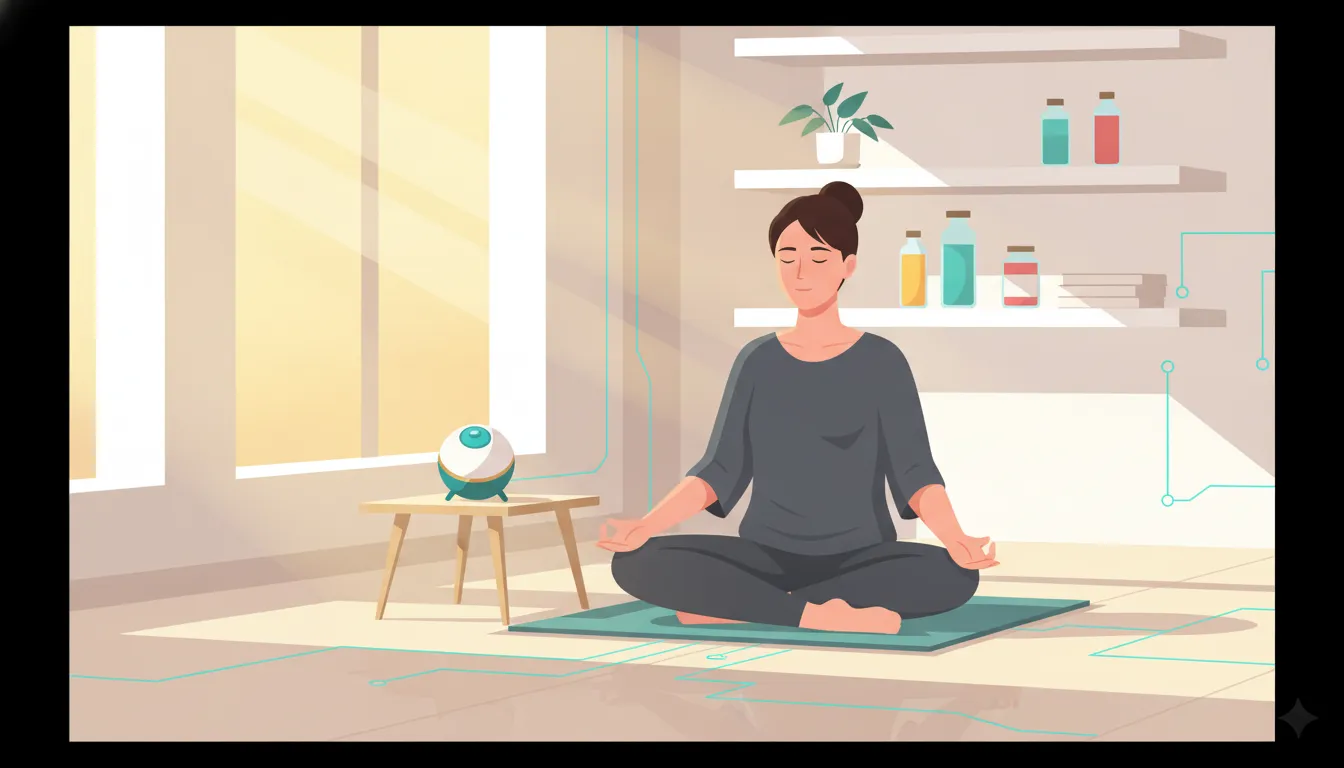
Brainwave entrainment tools use patterned sensory input, such as light and sound, to support a deliberately selected mental state. Upper Aeon's Vizr device sits within this category. It is best understood as a structured sensory practice, not a promise of a universal result. Users should pay attention to comfort, timing, and their response rather than assuming that a particular setting will produce the same outcome for everyone.
For a deeper explanation of the underlying concept, see this guide to brainwave entrainment and light-sound therapy. Neurofeedback adds a feedback loop by measuring brain activity and using that information to help a person practice changes in brain state. One study examined individual alpha-based neurofeedback learning as an ecological approach to neuromodulation and cognitive capacity, supporting a more precise conversation than generic claims about activating the brain. Read the alpha neurofeedback study for the research context.
Light, wearables, and metabolic signals
Light therapy works partly through timing and environmental context. Research on circadian-effective light has examined its relationship with alertness in office workers, making light exposure a practical consideration for people managing demanding schedules. The goal is not simply more brightness. Morning versus evening exposure, intensity, duration, and individual sensitivity can all affect how a protocol fits into a sleep-wake routine. The CDC-hosted report on circadian-effective light and alertness provides the relevant evidence.
Wearables offer another layer by tracking signals such as movement, heart rate, sleep estimates, or changes associated with training and recovery. These measurements can reveal patterns, but they remain proxies rather than complete portraits of health. Use them to ask better questions, then compare the data with subjective energy, mood, concentration, and recovery. This prevents a dashboard from becoming the authority over your lived experience.
Metabolic approaches extend the same principle to nutrition and energy regulation. Research on leveraging metabolic processes for better health presents biohacking as an effort to work with biological pathways, not bypass them. That may involve examining meal timing, physical activity, and other inputs within an individualized plan. If you want to explore tools that support this broader ecosystem, you can SHOP NOW through Upper Aeon's Top Sellers collection.
The most responsible technology stack is intentionally modest: choose one target, establish a baseline, use one intervention consistently, and review the response. Consider possible physiological costs when changing nervous-system states, as discussed in research on the costs of hacking the nervous system. Technology should sharpen awareness and support sustainable performance, while human judgment remains central.
How to Start Conscious Biohacking: The Earth 2.0 Framework
Starting well means building a relationship with your biology before adding more interventions. The Earth 2.0 framework treats optimization as an integrated practice, combining ancient wisdom, nervous system science, embodiment, and carefully chosen technology. Use these steps to create a system that supports conscious evolution rather than chasing isolated performance spikes.
-
Define the outcome you want to embody
Begin with a clear outcome, not a device or supplement. Decide whether your priority is steadier energy, emotional regulation, clearer thinking, resilient leadership, or a more grounded relationship with your body. This gives your practice a direction and creates a standard for evaluating what actually helps. The goal is sustainable peak performance, not constant stimulation or an endless search for the next hack.
-
Observe your current patterns
Before changing your routine, notice how your body responds across the day. Track sleep quality, energy, focus, tension, breathing, recovery, and the situations that leave you activated or depleted. This is an observational practice, not a diagnosis. Interoception, the awareness of internal bodily signals, is linked with autonomic nervous system regulation and plays a role in self-regulation and homeostasis. Read more about the signs and foundations of nervous system regulation as you establish your baseline.
-
Use the BDM Method to work with the whole system
The BDM Method gives the Earth 2.0 approach a structured foundation for conscious evolution and nervous system regulation. Rather than isolating the brain from the rest of the person, use the method to consider body state, attention, emotion, behavior, and environment together. Choose one small, repeatable practice that supports your stated outcome. Consistency provides more useful information than dramatic experiments that are difficult to repeat.
-
Build a System Reset into your rhythm
Use System Reset as a deliberate pause for returning to awareness and restoring capacity. That pause might include paced breathing, stillness, movement, sensory grounding, or another founder-tested practice suited to your needs. Traditional mind-body disciplines are relevant here because paced breathing and dynamic muscle contraction have been studied for their effects on autonomic nervous system reactivity (CDC study materials). Adjust the practice based on your response, and seek qualified support when symptoms are persistent or concerning.
-
Layer technology only after the foundation is clear
Technology can extend awareness, but it should answer a defined need. Consider data, light, neurofeedback, or another tool only after you understand the behavior or state you want to influence. Research on neurofeedback describes neuromodulation as an approach to optimizing brain state and cognitive capacity. But any intervention deserves attention to both intended benefits and possible physiological costs (neurofeedback research; nervous system ethics and risk review). In conscious biohacking, technology remains a tool within the practice, not the practice itself.
-
Apply the Earth 2.0 lifestyle in real environments
The final step is integration. Bring the framework into your work, relationships, recovery, and leadership, especially when decisions carry pressure. Earth 2.0 bridges ancient embodiment with modern health-optimization science, while conscious leadership helps translate regulation into how you communicate, choose, and respond. Review your observations regularly, keep what produces greater clarity and resilience, and release what creates dependency or strain. This turns optimization into an embodied way of living rather than a collection of disconnected experiments.
Frequently Asked Questions
What is conscious biohacking?
Conscious biohacking is the intentional use of embodied practices, nervous system awareness, and carefully chosen technology to support clarity, resilience, and sustainable performance. It is not purely spiritual or simply a collection of devices. Upper Aeon frames it as a bridge between ancient mind-body practices and modern scientific optimization.
How does biohacking align with nervous system regulation?
It begins with noticing internal signals, such as breath, tension, energy, and recovery, then selecting an appropriate intervention. Interoception, or awareness of the body's internal state, is linked with autonomic nervous system regulation and self-regulation (PMC10136905). The goal is not constant stimulation, but better-informed responses.
What are the core components of the Earth 2.0 lifestyle?
Earth 2.0 brings together nervous system science, immersive embodiment, biohacking technology, conscious leadership, and community. Upper Aeon's related frameworks include the BDM Method and System Reset. Together, they support a lifestyle that connects personal optimization with more conscious choices and relationships.
Can embodiment practices enhance biohacking results?
They can make optimization more experiential and sustainable by connecting data with how you actually feel and function. Research on paced breathing and dynamic muscle contraction has examined effects on autonomic nervous system reactivity (CDC, Understanding mind-body disciplines). Practices should be approached gradually and adapted to the individual.
Is conscious biohacking just for elite athletes?
No. The approach can serve executives, entrepreneurs, creators, practitioners, parents, and anyone seeking greater clarity or resilience. You do not need advanced equipment to begin. A consistent breathing practice, reflective check-in, or recovery routine can provide a grounded starting point before adding technology.
Ready to Begin Your Conscious Biohacking Journey?
Upper Aeon brings embodied practice and modern biohacking into a practical path for exploring clarity, resilience, and conscious growth. Choose tools that support your intentions, then build a routine you can engage with consistently.
Get started with products selected for your Earth 2.0 lifestyle: