

Modern footwear, indoor living, and constant device use have reduced the amount of direct contact many people have with the Earth's surface. That shift raises a practical question: could reconnecting with the planet's electrical environment support the systems responsible for recovery, stress regulation, and resilience?
Grounding science examines how direct contact with the Earth may connect the conductive body to the planet's global electrical circuit. Early research suggests this may influence inflammatory signaling, autonomic balance, and sleep, while grounding can complement, not replace, sensible strategies for reducing environmental electromagnetic stress.
The evidence is promising but still developing, so the strongest approach is precise rather than absolute. Understanding the electrical relationship between the body and the Earth provides a useful foundation for evaluating inflammation, nervous-system regulation, and the role of grounding alongside broader electromagnetic hygiene.
Explore Qi-Shield and Qi-Max EMF protection products built for a grounded, regulated biohacking routine.
How Grounding Science Explains the Body's Connection to the Earth
Grounding science explains the connection this way. Direct skin contact with the Earth's surface lets the human body join the planet's global direct-current electrical circuit. Because the body contains water and electrolytes, it conducts electricity. Bare-skin contact with soil, grass, sand, or damp concrete reconnects it to the Earth's surface potential.
Grounding, or earthing, means making direct skin contact with the Earth's surface. Bare feet on soil, grass, sand, or another naturally conductive surface create a physical connection that insulated floors and synthetic footwear interrupt. The practice is not based on absorbing a vague form of energy. Its proposed mechanism is electrical: contact allows the body's electrical potential to interact with the Earth's surface potential.
The Earth's surface carries a negative electric potential relative to the atmosphere, with a reservoir of mobile electrons available at the interface. Because the human body contains water and electrolytes, it is electrically conductive. When skin contacts the Earth, the body can join the planet's global direct-current electrical circuit rather than remaining electrically isolated from it. Oschman, Chevalier, and Brown describe this global circuit and the biological rationale for grounding in their 2015 review in the Journal of Inflammation Research (read the 2015 review).
What happens when electrons meet the body?
The central electron-transfer hypothesis is that free electrons from the Earth's surface may enter the body during direct contact. In this model, those electrons can help neutralize free radicals. Chemically reactive molecules that can contribute to oxidative stress when their production exceeds the body's ability to control them. This is why grounding science often frames the Earth as an external electron source with potential antioxidant relevance. Not as a substitute for the body's own enzymatic antioxidant systems. The hypothesis remains an area of investigation, and the strength of evidence varies across outcomes and study designs.
Why modern life changes the connection
For most of human history, contact with soil, stone, and other natural surfaces was routine. Modern indoor living has changed that baseline. Rubber and synthetic soles function as electrical insulators, while flooring, furniture, and long periods inside further reduce opportunities for direct contact. This does not prove that disconnection causes disease, but it explains why researchers study grounding as a distinct environmental variable. Re-establishing contact can be as simple as spending time barefoot outdoors, provided the surface is safe and the practice is appropriate for the individual. Anyone exploring a more regulated routine can also review how Upper Aeon explains nervous system regulation as a daily practice.

What Does the Research Show About Grounding and Inflammation?
The research shows early signals, not settled proof: grounded participants in small trials reported reduced muscle soreness. And reviewers observed changes in white blood cells and inflammatory markers after contact with the Earth. The strongest work is a 2015 review in the Journal of Inflammation Research and a 2023 review proposing an electron-transfer mechanism for anti-inflammatory effects.
The most useful evidence is not a promise that standing barefoot cures disease. It is a set of early observations suggesting that contact with the earth may influence inflammatory signaling and recovery after physical stress. In their 2015 review in the Journal of Inflammation Research, Oschman, Chevalier, and Brown examined studies measuring changes in blood and symptoms after grounding. The review discusses measurable differences involving white blood cells, cytokines, and other inflammatory molecules, while also identifying important gaps in the evidence.
One of the more relevant areas was delayed onset muscle soreness (DOMS), the pain and stiffness that can follow unfamiliar or strenuous exercise. In the experiments discussed by the authors, grounded participants reported reduced pain, and researchers observed changes in circulating neutrophils and lymphocytes. These findings do not establish grounding as a treatment for muscle injury. They do suggest a plausible research direction: whether contact with the earth can affect the inflammatory response that accompanies tissue stress and recovery. Read the full 2015 review and its study details.
Why inflammatory markers matter
Inflammation is a coordinated immune response, not a single substance that can simply be switched off. White blood cells, cytokines, and related signaling molecules help direct repair and defense. The question for grounding research is therefore more specific than whether it is "anti-inflammatory." Researchers are asking whether grounding changes the timing. Intensity, or balance of these responses, particularly after exercise or other physiological stress.
A 2023 review by Sinatra and colleagues, titled Grounding: the universal anti-inflammatory remedy, presents grounding as having potential anti-inflammatory and antioxidative effects. Its proposed model centers on the earth as a source of electrons that could influence oxidative processes and inflammatory pathways. That framing is mechanistic, but it remains a research hypothesis rather than a settled clinical conclusion. Review the 2023 Biomedical Journal paper. The deeper mechanics of oxidative stress and recovery also connect to Upper Aeon's evidence-based guide on cellular energy and mitochondria support.
The evidence needs a clear boundary
Most grounding studies remain small pilot trials, with limited sample sizes, varying protocols, and outcomes that require replication. Reviews can identify consistent signals and propose mechanisms, but they cannot substitute for large, independently replicated clinical trials. Grounding may be a low-cost complementary practice for people exploring recovery and nervous system regulation. It should not be presented as a licensed cure, a replacement for medical care, or a reason to stop treatment for an inflammatory condition.
How Does Grounding Regulate the Nervous System and Sleep?
Grounding may nudge the autonomic nervous system toward parasympathetic activity, the rest-and-repair state associated with recovery. Two small human studies provide the main signals: one linked grounding to improved heart-rate variability during emotional stress. And another associated overnight grounding with a more natural cortisol pattern and better reported sleep.
Grounding may influence the nervous system through changes in autonomic balance, the body's stress-response circuitry, and overnight cortisol patterns. The evidence remains early and should not be treated as proof that earthing treats insomnia or stress-related illness. However, two small human studies provide useful signals about measurable physiological outcomes. For a science-backed overview of the wider topic, see Upper Aeon's guide to nervous system regulation.
Autonomic balance and heart rate variability
The autonomic nervous system continuously adjusts heart rate, vascular tone, digestion, and recovery in response to perceived demands. Heart rate variability (HRV) is one non-diagnostic measure of that regulation. Higher or more adaptable HRV can be consistent with stronger parasympathetic influence, but it is affected by breathing, fitness, sleep, medication, hydration, and measurement conditions.
In a 2011 Integrative Medicine study, Chevalier and Sinatra examined 27 participants during an emotional-stress protocol. Grounding was associated with improved HRV beyond basic relaxation, with the reported between-condition result reaching P < .01. That finding suggests a shift toward more adaptive autonomic tone, not a guaranteed clinical outcome. It supports the customer framework that grounding may help manage an overactive autonomic response and emotional reactivity, while the small sample size calls for larger controlled studies. Those wanting to train this same signal directly can explore HRV biofeedback training.
For a broader explanation of this outcome, read Upper Aeon's guide to nervous system regulation. Grounding can be considered one input within a wider system that may also include slow breathing, consistent sleep timing, movement, and deliberate recovery practices. Science-backed practices that pair well with it include vagus nerve exercises for stress relief.
Nighttime cortisol and sleep quality
Ghaly and Teplitz reported in the Journal of Alternative and Complementary Medicine in 2004 that grounding during sleep lowered nighttime cortisol. It also shifted the daily cortisol pattern toward a more natural circadian rhythm. Participants also reported improvements in sleep, pain, and stress. The study is frequently cited in discussions of grounding science. Its findings should still be interpreted in context: a single study cannot establish causation, and subjective outcomes can be influenced by expectations and other changes in routine. The report is indexed as PMID 15650465.
A plausible interpretation is that grounding may support downshifting at night for some people, making it easier to remain in a restorative state. It is more accurate to describe the research as a signal involving cortisol timing and reported sleep experience than to claim that grounding directly normalizes every person's hormones or resolves sleep disorders. If persistent insomnia, severe fatigue, or significant pain is present, medical evaluation remains appropriate.
In practice, track the response rather than assuming it. Note bedtime, awakenings, morning energy, stress, and any relevant changes in caffeine, training, or screen exposure. That approach keeps the practice grounded in observable outcomes while respecting the limits of the current evidence.
Practical Ways to Ground: Barefoot Walking, Mats, and Sheets
The practical ways to ground are simple: walk barefoot on grass, soil, sand, or damp concrete for 10 to 40 minutes. Or use a properly grounded indoor grounding mat at a desk, or sleep on a conductive grounding sheet with a verified connection. Consistency matters more than session length, and a short daily practice beats an occasional long one.
The most useful grounding practice is the one you can repeat without friction. Direct contact with grass, soil, sand, or damp concrete is the simplest option, while conductive mats and sheets can bring the practice indoors. The practical-applications review describes sessions in the range of 10 to 40 minutes, but consistency matters more than chasing a long duration. A short daily practice is more valuable than an occasional marathon session.
- Walk barefoot outdoors for 10 to 40 minutes. Choose a clean, safe surface such as grass, soil, sand, or damp concrete. Damp ground generally offers better conductivity than a dry, insulated surface. Let the practice be unhurried: walk slowly, stand, or sit with bare feet in contact with the surface. The review of practical applications discusses grounding in this time range: read the practical-applications review. Check the area for sharp objects, extreme temperatures, and other hazards before beginning.
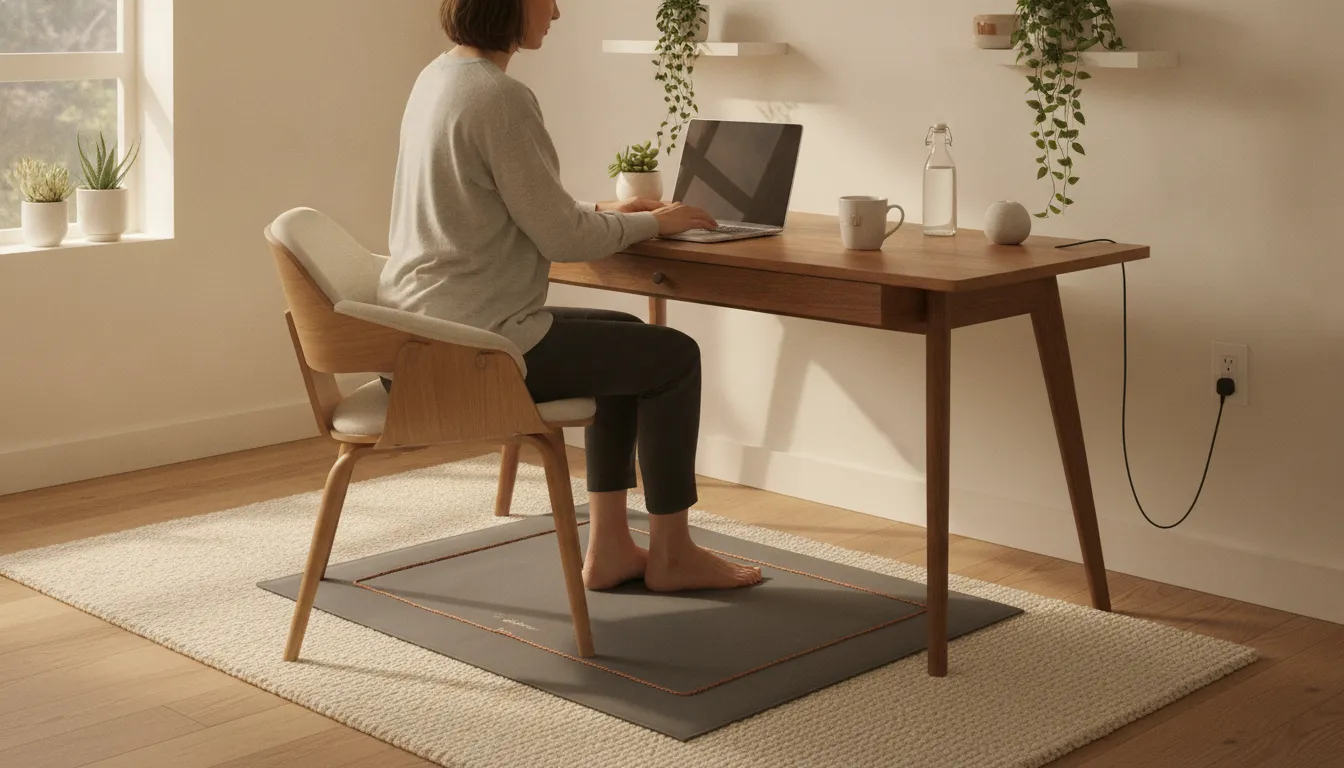
- Use a grounding mat during desk work. A mat can make grounding more consistent when weather, mobility, or an urban environment keeps you indoors. Place it where bare skin can make reliable contact, such as beneath your feet while working. Before relying on any device, review how a grounding mat differs from other recovery technologies. The equipment must be properly grounded to the earth's potential. It is not enough for a cord or accessory to look connected: the setup needs a functioning path that closes the electrical circuit.
- Try a grounding sheet during sleep. A conductive sheet can extend the practice through a nightly routine, provided the installation is verified and the sheet maintains appropriate skin contact. Follow the manufacturer's setup instructions, test the ground connection when the product allows it, and stop using the equipment if it is damaged or improperly fitted. Those seeking thoughtfully selected premium grounding tools should still evaluate specifications and compatibility before purchase.
- Pair grounding with breathwork and an evening wind-down. Use a few minutes of slower, comfortable breathing while walking, sitting at your desk, or preparing for sleep. Keep the sequence simple: reduce stimulation, connect with the earth, breathe steadily, and repeat tomorrow. This approach supports the broader goal of nervous system regulation without treating grounding as a replacement for medical care. Track sleep, energy, and stress responses over several weeks rather than judging the practice after one session.
| Method. | Best for. | Setup. | Key consideration. |
|---|---|---|---|
| Barefoot walking outdoors. | Morning routine, post-training recovery. | None; direct skin contact with grass, soil, sand, or damp concrete. | Check the surface for hazards; damp ground conducts more effectively than dry surfaces. |
| Grounding mat. | Desk work and screen-heavy hours. | Conductive mat connected through a verified ground path. | The circuit must actually close; a labelled product alone is not proof of function. |
| Grounding sheet. | Sleep and overnight recovery. | Conductive bedding with a functioning grounded cord. | Follow manufacturer instructions and stop use if damaged or uncomfortable. |
Why Grounding and EMF Protection Work Together as Electromagnetic Hygiene
Grounding and EMF protection work together because they address different points in the same electrical system. EMF protection reduces external stressors from devices and wireless signals, while grounding supports the body's internal electrical regulation through direct contact with the Earth's surface potential. One manages the exposure, the other supports the body's balance.
Electromagnetic hygiene is a two-part practice. First, reduce unnecessary exposure to external electromagnetic stressors by making thoughtful choices about devices, distance, placement, and protective tools. Second, support the body's own electrical regulation through grounding, which reconnects the body with the earth's electrical potential.
These strategies address different points in the same system. Qi-Shield and Qi-Max are designed to help reduce the electromagnetic burden in the surrounding environment. Grounding does not remove every source of exposure, and it should not be presented as a medical treatment. Instead, Upper Aeon's knowledge base describes it as a conductive pathway that may help stabilize the body's electrical potential in the presence of environmental EMF. This is a complementary framework, not a promise of immunity or cure. For a primer on whether ambient radiation is a real concern, see is EMF radiation real, and for the physics behind protective materials, review EMF blockers and shielding physics.
Reducing external stressors
Modern life places us near wireless networks, phones, computers, appliances, and other electrical infrastructure for much of the day. Practical exposure reduction remains the first step: create distance from active devices, avoid unnecessary contact, and review bedroom and workspace habits. The EMF protection guide offers a broader set of household considerations.
Protective products can fit into that strategy when they are used as part of a considered environment rather than as a substitute for basic habits. Qi-Shield and Qi-Max EMF shielding tools belong within an intentional biohacking routine, alongside sensible device management and restorative practices.
Supporting internal electrical regulation
Grounding adds the second layer. Direct contact with the earth may provide access to surface electrons and help balance the body's electrical potential with the earth's natural potential. The customer knowledge base identifies this stabilization as one possible way grounding may support the body's response to environmental EMF. While also connecting the practice with nervous system regulation and antioxidant capacity. These mechanisms remain an area of ongoing research, so the responsible position is to describe grounding as supportive rather than curative.
In practice, that can mean barefoot contact with soil, grass, or sand, or a properly connected indoor grounding setup when outdoor access is limited. Consistency matters more than turning the practice into another performance metric. A short grounding session can become a transition between screen-intensive work and sleep, training and recovery, or stimulation and focused breathing.
This is the logic behind Upper Aeon's Earth 2.0 lifestyle: reconcile ancient embodiment practices with modern science and technology. Electromagnetic hygiene is not about fear of the modern world. It is about creating conditions that support clarity, resilience, and a more regulated relationship with the environments in which we live and work. For a wider set of exposure-reduction tactics, start with the EMF protection guide and pair it with a grounded evening routine.
Shop Qi-Shield and Qi-Max to pair EMF shielding with your grounding practice.
What Grounding Science Might Not Do: An Honest Look at the Limits
Grounding science does not establish that earthing cures disease, prevents illness, or replaces medical care. The published literature is mostly small pilot trials and mechanistic reviews. So the honest position is that grounding is a promising complementary practice with a developing evidence base, not a settled clinical intervention.
Grounding is promising, but its evidence base is still developing. Much of the published literature consists of small pilot trials, observational work, and mechanistic proposals rather than large, independently replicated clinical trials. That distinction matters. Early findings can justify further research, but they cannot establish that grounding treats a disease, prevents illness, or produces the same result for every person.
The 2015 review by Oschman, Chevalier, and Brown describes possible effects involving inflammation, blood flow, and recovery, while also calling for more rigorous controlled research. A 2023 review by Sinatra and colleagues similarly presents grounding as a developing area of investigation, not a settled clinical intervention. Neither source supports replacing diagnosis or treatment with barefoot walking, mats, or conductive bedding.
For a balanced clinical overview, the Cleveland Clinic's explanation of earthing notes that some studies report potential benefits, while the research remains limited and more high-quality evidence is needed. This is the appropriate standard for interpreting the practice: interested, observant, and careful about cause and effect.
Use grounding as a complement, not a cure
Grounding may be a low-cost addition to a broader routine that includes sleep, movement, stress regulation, nutrition, and appropriate medical care. It can also be personally meaningful without being presented as a guaranteed biological solution. Track practical outcomes such as perceived relaxation or sleep quality, but avoid assuming that a subjective improvement proves a specific mechanism or resolves an underlying condition.
If you have persistent pain, cardiovascular symptoms, sleep disruption, inflammation, or another health concern, speak with a qualified clinician. Continue prescribed care and ask about potential safety considerations before using grounding equipment. The most credible position is neither dismissal nor hype: grounding science is worth studying, and its current limits should remain visible. For somatic options that pair with it, Upper Aeon's guide to touch therapy for stress relief and its nervous system regulation signs and recovery guide round out an evidence-based routine.
Frequently Asked Questions
Is there scientific evidence for the health benefits of grounding?
Early studies and reviews suggest potential effects on inflammation, autonomic balance, cortisol, sleep, and recovery, but the evidence base remains developing. Oschman, Chevalier, and Brown describe possible anti-inflammatory mechanisms involving electron transfer, while the available studies should be interpreted as preliminary rather than proof that grounding treats disease. Review the 2015 Journal of Inflammation Research paper.
What does the science say about grounding for stress and cortisol?
Grounding may support a shift away from sympathetic stress dominance toward parasympathetic activity. A 2011 study by Chevalier and Sinatra involving 27 participants reported improved heart-rate variability measures associated with autonomic tone, while Ghaly and Teplitz studied cortisol patterns and sleep. These findings are promising, but they do not establish a guaranteed stress response for every person.
How long should you practice grounding?
There is no universally established minimum duration or clinically validated dose. A practical approach is to begin with a consistent, comfortable session. Such as a few minutes of barefoot contact with grass, soil, or sand, and observe how you respond. The customer research context emphasizes consistency over duration, so a sustainable daily habit is more useful than occasional, exhausting sessions.
Can indoor grounding products mimic direct Earth contact?
Conductive mats and sheets are designed to provide a connection to earth potential when direct outdoor contact is impractical. Their effectiveness depends on a verified, properly functioning ground connection, not simply on the product being labeled conductive. Use equipment according to its instructions, and stop if it causes discomfort or skin irritation.
Is grounding a replacement for medical care?
No. Grounding can be treated as a complementary wellness practice that may support relaxation, recovery, and nervous-system regulation. It should not replace diagnosis, prescribed treatment, or professional advice, particularly for persistent inflammation, sleep problems, pain, or other symptoms that require clinical evaluation.
Ready to Build a Grounded EMF Protection Routine
Grounding can be one part of a consistent electromagnetic hygiene practice, especially when paired with thoughtful habits that support nervous system regulation. To explore Qi-Shield and Qi-Max EMF protection products, shop the Upper Aeon top sellers. Choose the tools that fit your environment, then build a routine you can use with intention and consistency. To go deeper with like-minded practitioners, join the Earth 2.0 community.